


Tsum Valley Trek with Gompa Lungdang – 16 days

Trip Duration
16 Days
Group Sizes
2-16 People
Transportation
Car, Jeep
Destination
Nepal
Max. Altitude
4,200m. / 13,780ft.
Best Season
Mar-May & Oct-Nov
Activities
- Trekking
- Cultural Sightseeing

Difficulty
Difficult
Meals
- Breakfast
- Lunch
- Dinner

Start & End Point
Kathmandu/Kathmandu
Accommodation
- Hotel
- Teahouse
Trip Highlights
- Explore Milarepa Cave at 3,500 meters, where the 11th-century Buddhist master meditated.
- Drink butter tea inside Mu Gompa monastery, founded in the late 19th century.
- Navigate the Suri Khola steel suspension bridge.
- Spot Ganesh Himal’s west face from Ngaku at 3,200 meters.
- Spin prayer wheels at Gomba Lungdang nunnery monastery.
- Eat dal bhat in Chumling village, surrounded by mani walls carved with Tibetan script.
- Walk through Dumje’s rhododendron forests, blooming crimson in April.
- See yak caravans carrying Tibetan salt across the Budhi Gandaki River.
- Pass through Ripchet’s hilltop settlement at 2,468 meters.
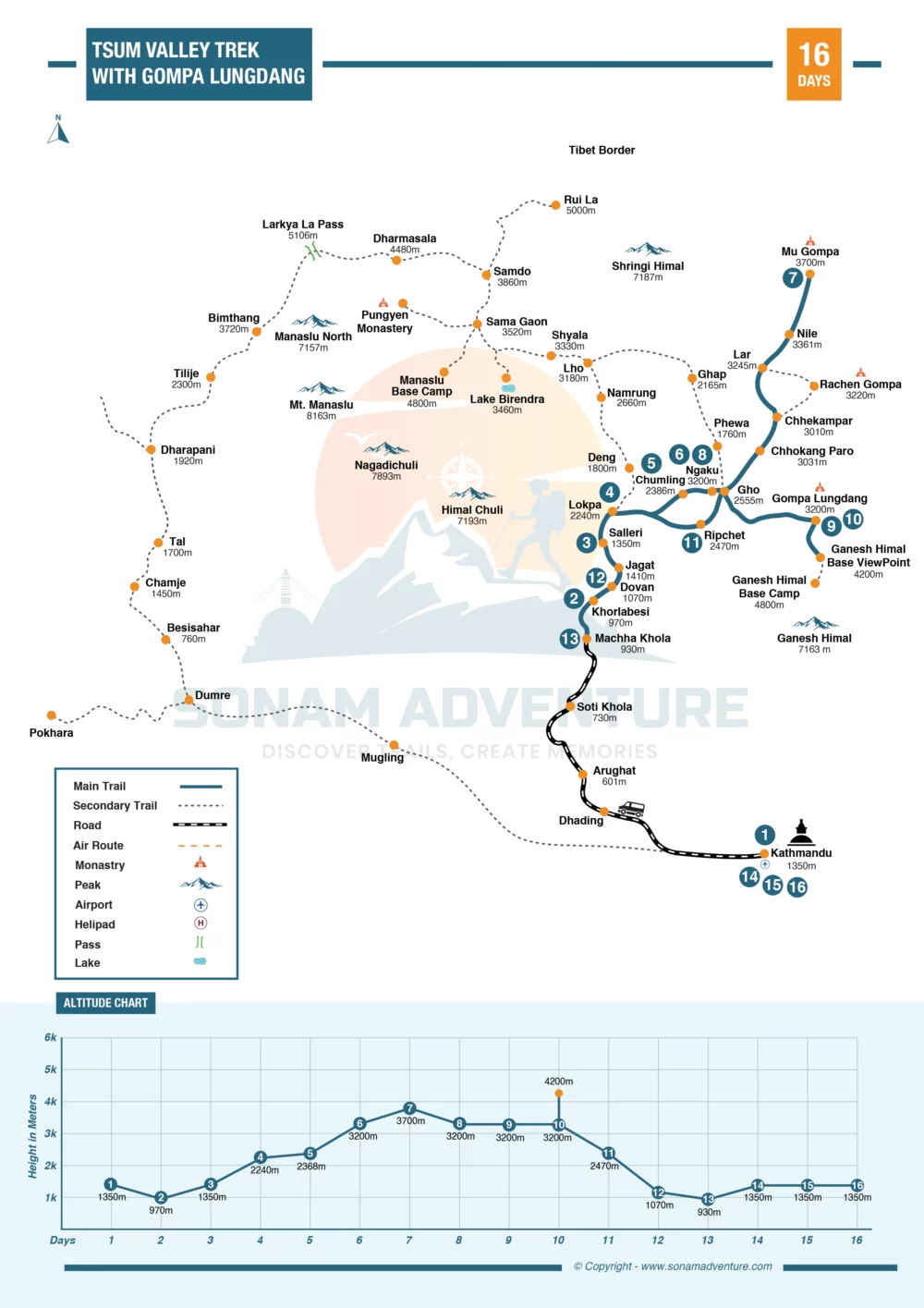
Overview of Tsum Valley Trek with Gompa Lungdang – 16 days
The Tsum Valley Trek with Gompa Lungdang remains one of Nepal’s last untouched cultural sanctuaries. You enter a restricted region home to fewer than 2,000 Tsumba people who speak a distinct Tibetan dialect. This hidden valley preserves 800-year-old Buddhist traditions unchanged by modern tourism.
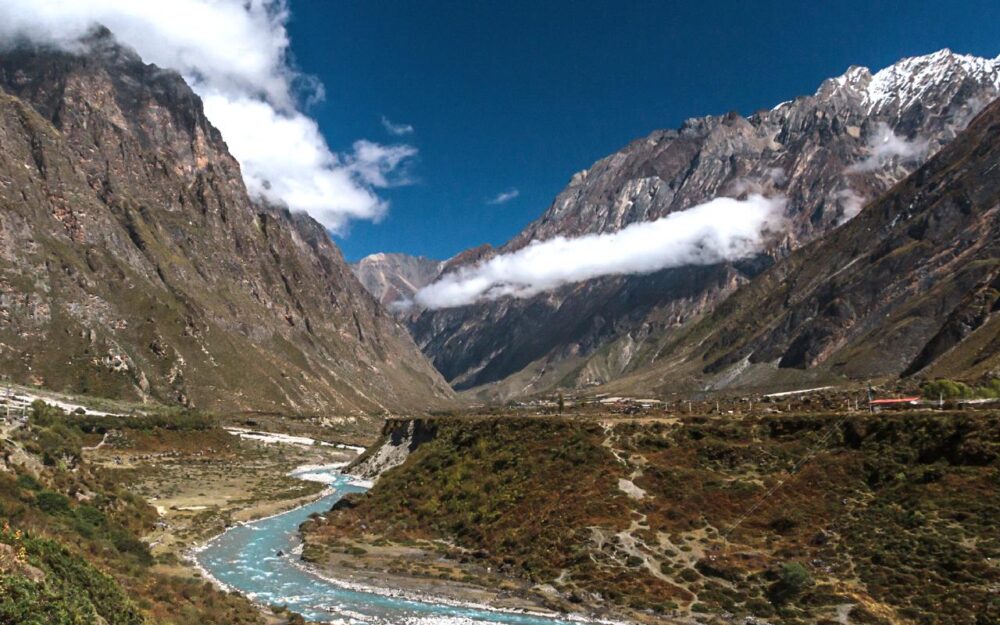
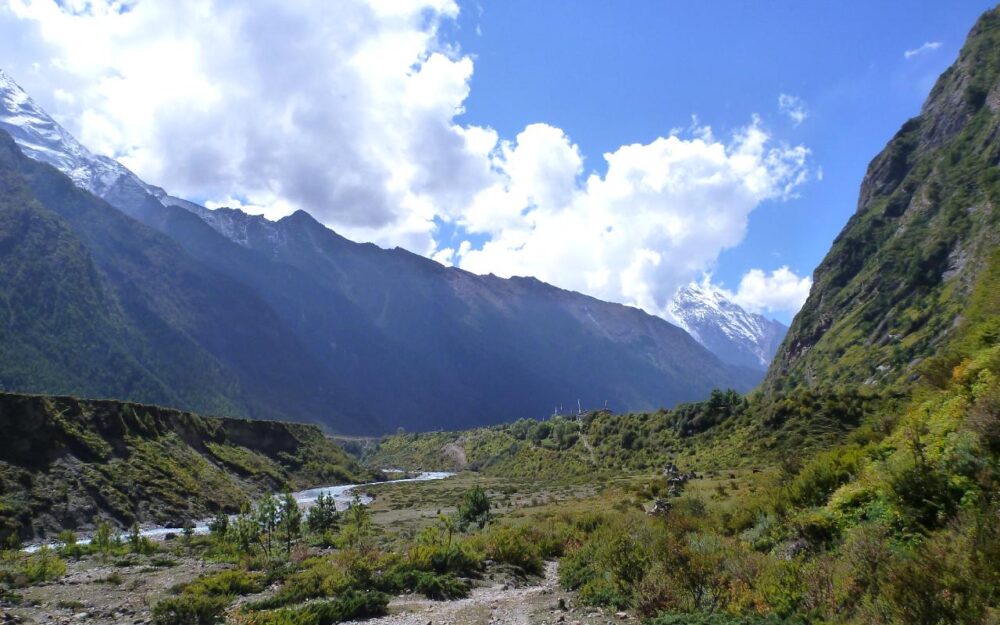
We guide you through 16 days across Gorkha District’s remote trails, where mani walls line every path and prayer flags mark sacred sites. Your journey starts at 910 meters in Khorlabesi and climbs to 4,200 meters at Ganesh Himal Base Viewpoint. The Budhi Gandaki River valley forms your constant companion through pine forests and barley fields.
You passed the Mu Gompa monastery, founded in the late 19th century, when monks still performed ancient rituals. Tsumbas follow a unique blend of Nyingma Buddhism, where they believe everything has a soul. Their villages, like Chumling, feature stone houses with slate roofs and intricate wood carvings.
These aesthetic and charming villages have been attracting thousands of visitors every year, offering a great getaway from busy city life. However, before getting on the Tsum Valley Trek with Gompa Lungdang, you need to make sure that you are scheduled for the right season.
Monsoon season blocks trails from June to September, making October-November the prime window. Daytime temperatures range from 25°C in Machakhola to freezing at Ngaku. Regardless of the seasons, you present permits at the Philim checkpoint, where police verify your restricted area authorization.
This route avoids Everest’s crowds while delivering comparable cultural depth. You witness the Lhosar festival if trekking in January or February, where masked dancers perform century-old rituals.
The valley’s isolation preserved traditions make us feel like we are lost elsewhere in the Himalayas. We ensure your trek supports local teahouses following Nepal’s community tourism model. This is not another commercialized trail but a living cultural corridor.
Your footprints join centuries of Tibetan traders and Buddhist pilgrims. We guarantee minimal group sizes to protect the fragile ecosystem. This journey demands physical readiness but rewards with unparalleled authenticity. This valley remains Nepal’s best-kept secret for those willing to earn its rewards.
Itinerary of Tsum Valley Trek with Gompa Lungdang – 16 days
Day 01: Arrival in Kathmandu (1,400m)
You land at Tribhuvan International Airport, where our Tsum Valley Trek with Gompa Lungdang guide greets you with your name clearly displayed.
We transfer you directly to your Kathmandu hotel through the city’s busy streets. Your pre-arranged room provides immediate rest after your flight.
Before dinner, we conduct your mandatory trek briefing covering the full 16-day schedule. You verify your restricted area permit for the Tsum Valley region.
We check your oxygen saturation levels, which should read around 96 percent at 1,400 meters of elevation. Acclimatization begins immediately as you are resting at 1400 meters in Kathmandu.
We expect you to drink 3 litres of water throughout the day, although the trekking days have not yet started.
Rest your body fully, as tomorrow requires an 8-hour drive. Sleep early to adjust to Nepal’s time zone before the journey starts.

Accommodation
HotelMeals
Breakfast
Max Altitude
1400mDay 02: Drive to Khorlabesi- 910m (8-9hrs drive)
We depart Kathmandu at first light in a sturdy 4×4 vehicle. The road follows the Trishuli River for 150 kilometres through terraced farmlands and local settlements.
After Sotikhola, the route enters the Budhi Gandaki valley with steep river gorges on your left. You navigate rough road sections requiring slow progress near Arughat Bazaar. We stop for lunch at a basic roadside eatery serving dal bhat.
Our Tsum Valley Trek with Gompa Lungdang porters secure your luggage on the vehicle roof using strong ropes. The drive ends exactly at the Khorlabesi teahouse as per your itinerary.
Net elevation drops from 1400 meters above Kathmandu to 910 meters. Your muscles feel stiff from the long ride, but you rest well for tomorrow’s trek.

Duration
8-9hrs driveAccommodation
TeahouseMeals
B L DMax Altitude
910mDay 03: Trek to Salleri- 1,500m (6hrs)
You start walking from Khorlabesi’s riverbank trailhead at 8 AM sharp, starting the 3rd day of the Tsum Valley Trek with Gompa Lungdang. The path ascends steadily through subtropical forests alongside the Budhi Gandaki River.
You cross multiple suspension bridges with wooden slats over rushing tributaries. Waterfalls appear frequently along the route, falling strongly down slippery, mossy cliffs. The trail gains 590 meters of net elevation with consistent uphill sections on rocky paths.
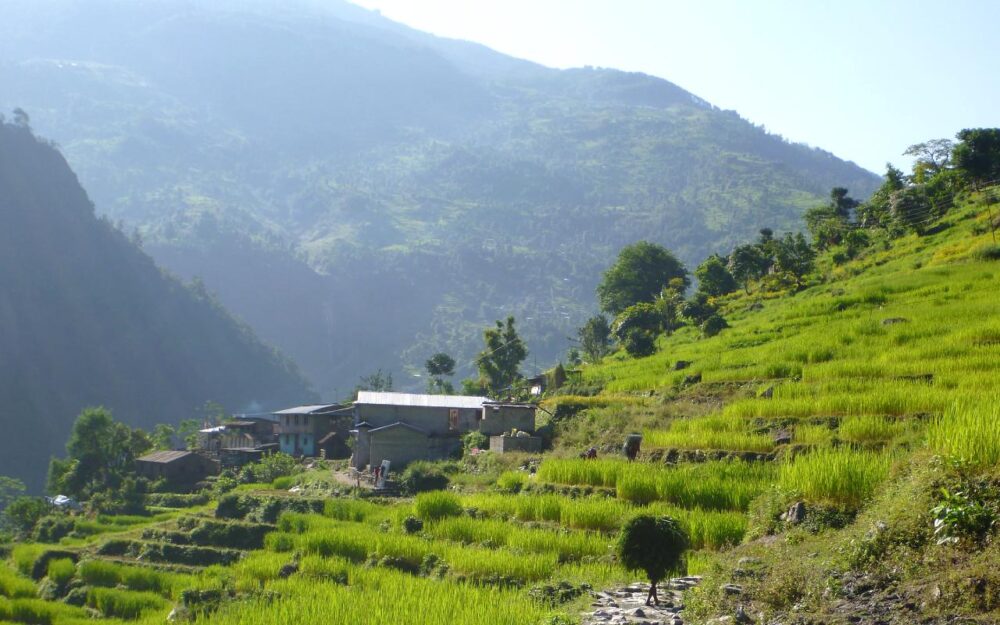
You pass traditional villages where Gurung farmers work terraced fields. Porters carrying heavy loads overtake you using forehead straps.
After exactly 6 hours of walking, you reach Salleri at 1,500 meters. Your stone teahouse provides basic but clean accommodation. Tomorrow, we enter the Tsum Valley restricted zone at Philim.
Duration
6hrs trekAccommodation
TeahouseMeals
B L DMax Altitude
1500mDay 04: Salleri to Lokpa- 2,240m (6hrs)
We leave Salleri at dawn, walking toward the Philim checkpoint. You present your restricted area permit to Nepali police officials, who stamp your documents for Tsum Valley entry. The trail ascends 740 meters net through dense pine forest with sharp switchbacks.
You cross the Nadi River via a suspension bridge, testing your balance a little as it sways left and right. After three hours, you enter traditional Tsumba territory where prayer flags mark sacred spaces.
The path steepens near Chhokate village with 30-minute climbs on rocky sections. You pass yak pastures where herders greet you with “Tashi delek.” We reach Lokpa teahouse at exactly 2,240 meters after six hours.
Your room offers basic bunk beds with shared bathrooms. Day 5 brings deeper cultural immersion in Tibetan-influenced villages.
Duration
6hrs trekAccommodation
TeahouseMeals
B L DMax Altitude
2240mDay 05: Lokpa to Chumling- 2,380m (5hrs)
You start walking at 7:30 AM through an ancient rhododendron forest still damp from morning mist. The trail gains 140 meters of net elevation but includes constant small ascents and descents.
You cross three suspension bridges over the Budhi Gandaki tributaries. Near Ripchet village, you see your first mani walls carved with Tibetan prayers. Chortens appear frequently along the path, wrapped in prayer scarves.
We stop for lunch at a stone teahouse serving steaming thukpa soup. The final hour reveals Chumling’s traditional stone houses with slate roofs. You arrive at 2,380 meters after approximately five hours of walking.
Your Tsum Valley Trek with Gompa Lungdang guide explains Tsumba Buddhist customs over dinner. Pack warm layers tonight as nighttime temperatures drop below 10°C.
Duration
5hrs trekAccommodation
TeahouseMeals
B L DMax Altitude
2380mDay 06: Chumling to Ngaku- 3,200m (6hrs)
We begin walking at first light, ascending through barley fields where locals harvest using sickles. The trail gains 820 meters of net elevation with sustained uphill sections on gravel paths.
You pass yak caravans carrying goods from different regions with bells jingling on the lead animals. Ganesh Himal peaks appear clearly at 3,000 meters through valley openings. The path narrows near Chhokpur village with 200-meter drop-offs into ravines.
We cross the Suri Khola River on a new steel suspension bridge. After four hours, you reach the high pasture of Chhokpur where yaks graze freely.
The final ascent to Ngaku involves steep switchbacks through juniper bushes. You arrive at 3,200 meters about six hours after leaving Chumling.
Duration
6hrs trekAccommodation
TeahouseMeals
B L DMax Altitude
3200mDay 07: Ngaku to Mu Gompa- 3,700m (6hrs)
We leave Ngaku at 7 AM, ascending through high-altitude pastures where yaks graze on sparse grass. Today’s trail gains 500 meters of net elevation on rocky moraine terrain.
You pass stone monasteries draped in faded prayer flags. After two hours, you reach Milarepa Cave, where the 11th-century Buddhist master meditated.
Your Tsum Valley Trek guide explains the cave’s significance while you examine butter lamp residue on ancient walls. The path steepens near Mu Gompa with 25-minute climbs on loose scree slopes.
We arrive at Mu Gompa monastery, reaching 3,700 meters above sea level after six hours of tiring trek. Your teahouse room faces Ganesh Himal’s western face. Nighttime temperatures drop to 5°C, so layer up immediately.
Duration
6hrs trekAccommodation
TeahouseMeals
B L DMax Altitude
3700mDay 08: Mu Gompa explores back to Ngaku- 3,200m (5hrs)
You explore Mu Gompa monastery at dawn, watching monks perform morning rituals in the main assembly hall. We hike to Rachen Monastery two kilometres south, where panoramic views reveal Ganesh Himal’s full ridge.
The descent to Ngaku begins at 10 AM, losing 500 meters of elevation over steep switchbacks. You navigate loose gravel paths requiring careful footing near drop-offs.
Porters carry your daypacks while you focus on balance during the 300-meter descent to the Suri Khola River. The final three hours follow the Budhi Gandaki River through juniper forests.
You reach Ngaku teahouse after around five hours of leaving Mu Gompa. Your room provides hot water bottles for cold nights. Rest your knees tonight after the sustained downhill walk.
Duration
5hrs trekAccommodation
TeahouseMeals
B L DMax Altitude
3200mDay 09: Ngaku to Gomba Lungdang- 3,200m (7hrs)
We start walking at 7:30 AM, crossing the Budhi Gandaki River near Dumje village. The river crossing requires deliberate steps on slippery boulders midstream.
After the river, you ascend 400 meters through dense pine forest on steep switchbacks. The trail gains minimal net elevation but includes significant undulations through forested ravines.
You pass herders guiding yaks with wooden staff near Chhokpur pasture. Porters rest every hour, fastening boots with leather patches. After four hours, you enter sacred territory marked by towering mani walls carved with Om Mani Padme Hum.
The final ascent to Gomba Lungdang nunnery involves a 200-meter climb through rhododendron forests.
You arrive at the remote monastery following a seven-hour trek. Your stone room overlooks the nunnery’s prayer wheel courtyard. Night temperatures require two blankets despite the same elevation as Ngaku.
Duration
7hrs trekAccommodation
TeahouseMeals
B L DMax Altitude
3200mDay 10: Day hike to Ganesh Himal Base Viewpoint (4,200 m)- 6 hours round trip
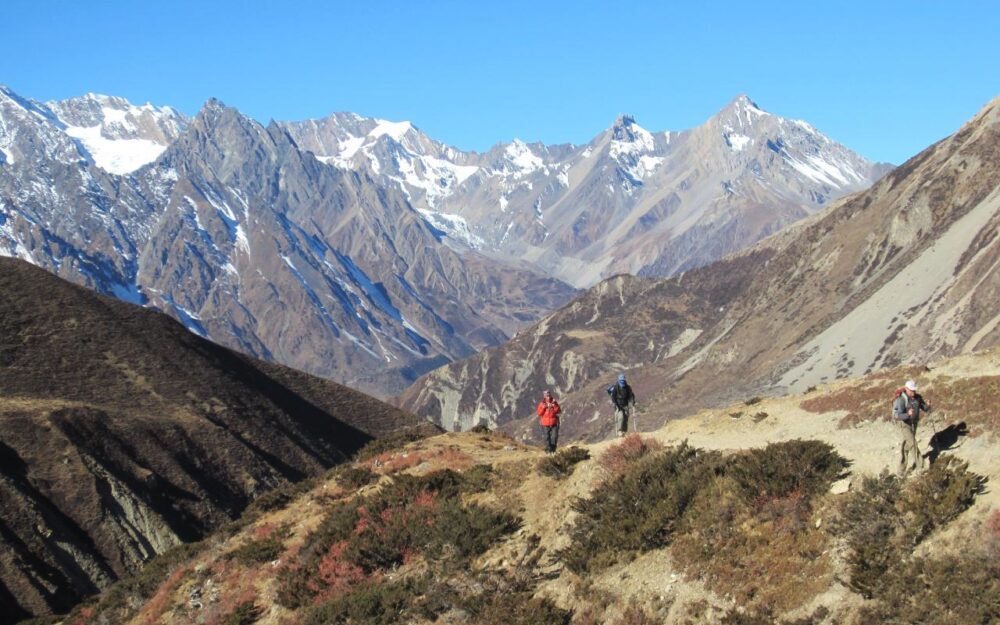
We start early at 6 AM for the steep climb to Ganesh Himal Base Viewpoint. The trail gains 1,000 meters of elevation in 3 hours over loose scree and glacial moraine. You navigate sharp switchbacks above 3,500 meters where oxygen feels thin.
After two hours, you reach the glacier’s edge, viewing icefalls calving into deep crevasses. We rest at 4,200 meters, examining Ganesh Himal’s west face up close. The descent requires careful footing on unstable rock sections near the moraine.
You lose elevation quickly over the first hour, testing your knee stability. We return to Gomba Lungdang teahouse around six hours after departure. Nighttime temperatures drop to freezing, so change into dry layers immediately.
Drink plenty of water to recover from the strenuous climb. Your Tsum Valley Trek with Gompa Lungdang guide confirms tomorrow’s descent route to Ripchet village.
Duration
6hrs trekAccommodation
TeahouseMeals
B L DMax Altitude
4200mDay 11: Trek back to Ripchet- 2,468m (6hrs)
You leave Gomba Lungdang at 7:30 AM, descending 732 meters net elevation to Ripchet. The trail loses altitude steadily through pine forests with frequent river crossings.
After two hours, you pass through Dumje village, where women weave traditional baskets. The path includes short ascents around slopes despite the overall descent.
Our Tsum Valley Trek porters carry your heavy packs while you manage knee strain on downhill sections. Near Ripchet, the trail steepens with 200-meter drop-offs along cliff edges.
You navigate rocky switchbacks through terraced potato fields worked by local farmers. We reach Ripchet’s hilltop settlement exactly six hours after departure. Your stone teahouse room overlooks the valley with basic shared facilities.
Duration
6hrs trekAccommodation
TeahouseMeals
B L DMax Altitude
2468mDay 12: Trek to Dovan- 1,070m (5hrs)
We begin walking at 8 AM, rejoining the Manaslu Circuit trail near Philim. The route descends 1,398 meters net elevation through subtropical forest to Dovan. You follow the Budhi Gandaki River on well-worn paths through rhododendron groves.
After three hours, you pass through Jagat village, where the locals sell fresh fruits based on seasonal availability. Near Dovan, the path narrows through terraced rice fields. You lose elevation rapidly in the final hour through dense bamboo forests.
Following a 5-hour trek from Ripchet, we arrive at Dovan teahouse. Your room provides basic bunk beds with shared cold-water bathrooms.
Duration
5hrs trekAccommodation
TeahouseMeals
B L DMax Altitude
1070mDay 13: Trek to Machakhola- 900m (4hrs)
Your legs burn during the final descent to Machakhola. Four hours of downhill walking through Gurung farming villages tests your knee stability.
You pass women carrying firewood bundles balanced on their backs with rope harnesses. Our guide points out wild cardamom plants growing near the trail. The air grows warmer as the elevation drops to 900 meters.
Terraced rice paddies give way to banana plantations in the subtropical zone. Machakhola’s teahouse serves steaming garlic soup upon arrival. Night temperatures feel humid compared to the higher valleys. Pack light for tomorrow’s drive since Kathmandu needs city clothes.
Duration
4hrs trekAccommodation
TeahouseMeals
B L DMax Altitude
900mDay 14: Drive back to Kathmandu- 8hours
Dust coats the vehicle during the 8-hour jeep ride. The vehicle bounces along river gorges where landslides sometimes block sections of road. Our driver navigates sharp turns near Lapubesi with expert precision.
You share roasted corn, sold by street vendors, with porters en route. The Trishuli River valley reveals terraced hillsides worked by Tamang farmers. Kathmandu’s traffic hits suddenly after weeks in remote highlands, and horns blare as motorbikes swarm the jeep.
Our Tsum Valley Trek with Gompa Lungdang guide verifies your final procedure details during the final hours of the day. Hotel showers feel luxurious after two weeks of bucket baths.
Duration
8hrs trekAccommodation
HotelMeals
BreakfastMax Altitude
1400mDay 15: Free day in Kathmandu
You can use the 15th day of the Tsum Valley Trek with Gompa Lungdang for sightseeing. However, this will not be a guided tour. If you want a guided tour, we can arrange it at a price.
Boudhanath Stupa hums with morning activity when you arrive at 7 AM. Monks chant inside the monastery while locals spin prayer wheels.
Swayambhunath Hill requires 365 steep steps but offers valley views worth the climb. Thamel’s narrow streets tempt you with pashmina shops and handicrafts.
Accommodation
HotelMeals
BreakfastDay 16: Final Departure
The final day of the Tsum Valley Trek with Gompa Lungdang is here. There are no alarm clocks waking you up today. You wake up at your own time, feel refreshed, and rested.
After breakfast, we will have you go over the end procedures to officially complete the journey. As per your flight time, one of our drivers and reps will have you dropped off at the airport, following a short farewell ceremony.
Accommodation
HotelMeals
BreakfastTrip Information - Good to Know
How does our trip start?
You land at Kathmandu airport and spot our Tsum Valley Trek with Gompa Lungdang guide holding your name sign within minutes after getting your visa approved. We whisk you directly to your hotel, avoiding unnecessary stops. Your room provides immediate rest at 1,400 meters.
Before dinner, we verify your restricted area permit and oxygen levels. We check your gear inventory, including a down jacket and a sleeping bag. Your guide explains emergency protocols and the preventive measures of altitude sickness.
We expect you to sleep early tonight and be well rested, as tomorrow requires an 8-hour drive to Khorlabesi. This critical preparation prevents you from being sleepy all day. We ensure you start strong with all permits confirmed before dawn departure.
Difficulty
The Tsum Valley Trek with Gompa Lungdang demands consistent daily walking with significant elevation changes. You face net gains up to 820 meters on Day 6 and steep descents like Day 11’s 732 meters. River crossing test balance on suspension bridges with wooden slats. High passes reach 4,200 meters, requiring careful oxygen management.
Trail surfaces include loose scree near Ganesh Himal base camp and rocky switchbacks in pine forests. Knee strain occurs during sustained descents, which sounds easy but is actually a major factor. Altitude can affect anyone above 3,500 meters above sea level, regardless of their experience, sex, fitness level, etc. Train with weighted daypacks on hilly terrain before departure if possible. On a scale of 10, our guides have rated it a solid 8.
Best seasons
October-November provides stable weather with clear Himalayan views and moderate temperatures. Daytime averages 15 to 20°C at lower elevations, dropping to 5°C at 3,200 meters. December-January brings colder conditions below, freezing at night, but fewer crowds. March-April offers spring blossoms with daytime temperatures reaching 25°C in valleys.
Avoid the monsoon season from June to September when landslides might block trails and leeches infest forests. Pre-monsoon March provides drier paths before April heat. Post-monsoon October has optimal visibility for Ganesh Himal views. Pack layers for temperature swings between valleys and high camps.
Altitude Sickness
Symptoms of altitude sickness appear slightly above 2,500 meters. A headache indicates mild sickness at 3,500 meters above sea level. We measure oxygen saturation daily using pulse oximeters. Descend around 200 meters immediately if nausea occurs. The guide will help you get through such cases.
We recommend that everyone drink at least 3 litres of water daily. Our guides carry dexamethasone for emergencies. Proper acclimatization days prevent over 90% of cases.
Rest at Salleri (1,500 m) before entering high zones and sleep at lower elevations than daytime peaks. Recognize severe symptoms of vomiting and severe shortness of breath. We evacuate within 2 hours using pre-arranged helicopters if the case gets serious.
Avoid alcohol during trekking days as it dehydrates your body, which can cause altitude sickness. The guide monitors pulse rates each morning. Most cases resolve with rest at the current altitude. Report symptoms before sleeping so the guide can help you better.
Accommodation, Food and Drink
Teahouses provide stone rooms with shared bathrooms at all elevations. Expect basic bunk beds or single beds with foam mattresses. We verify hot water availability daily as much as possible. Meals feature dal bhat lunch and dinner with unlimited refills. Portions include 3 chapatis (alternative), around 300 gms of rice and lentils, and 150 gms of vegetable curry.
Breakfast offers eggs, toast, and instant coffee, but it’s not the same for every teahouse. You can easily refill your water at different water sources en route. But always remember to use filter tablets. Teahouses filter river water through ceramic filters. Carry spare iodine tablets just in case you run out of it, or someone else in the group does.
Pack energy bars for high pass days. Drink 2 litres minimum during trekking hours and a total of 2 litres by the end of the day. Ginger tea and garlic soup combat altitude effects nightly.
Transportation
Jeeps cover 140 kilometres from Kathmandu to Khorlabesi. Roads become gravel after Dhading Besi, and monsoon damage can cause delays near Arughat. Experienced drivers like ours navigate the sharp and narrow turns with ease. Seatbelts remain fastened during river crossings, downhill, and uphill sections.
Luggage secures to the roof with nylon ropes. Eight-hour drives include one dal bhat stop and a couple more refreshment stops. Vehicles carry spare tires for landslide areas. We verify road conditions daily. Airport transfers use pre-booked sedans with name signs. Drive times vary by 2 hours based on monsoon damage.
Permit
You obtain a Tsum Valley Restricted Area Permit at Kathmandu’s Nepal Tourism Board office. Submit two passport photos and a passport copy. Processing takes a couple of hours; it costs USD 40 per week, along with USD 23 for the Manaslu Conservation fee, which is a part of the Tsum Valley Trek package.
Carry the original permit daily for police checks at Philim and other checkpoints along the way. Our guide handles paperwork, saving you some queueing time. Permits require a minimum of two trekkers, which is why we pair solo travellers.
We will submit applications on your behalf pre-departure. Lost permits delay trekking by 24 hours for replacement. We track permit regulations updated monthly by the official bodies of Nepal. Never share permit scans online; carry physical copies only.
Trip preparation and fitness
Walk 15km weekly with a 5kg daypack before departure. Train downhill on concrete stairs to strengthen knee stabilizers. Break in hiking boots on rocky terrain for 30 hours minimum. Pack trekking poles for river crossings and descents. Verify sleeping bag rating to -10°C for high camps.
Carry personal medication in original containers. Complete dental checkup since altitude can worsen tooth pain. Arrive in Kathmandu with a 3-day buffer for unforeseen circumstances such as flight cancellations, unfavourable weather, and more. We provide a gear checklist verified by our Tsum Valley Trek guides. Fitness prevents 70% of trail emergencies.
Alternative routes
Manaslu Circuit diversion adds 2 days at 4,000m elevation near Samdo village. Requires an additional 15 USD conservation fee. Landslide reroutes use old foot trails bypassing the Arughat road section. Monsoon alternatives descend to Machha Khola, avoiding Khorlabesi road debris. Helicopter evacuation points exist at Jagat and Philim landing zones.
Weather diversions may be shortened to 12 days, skipping the Ganesh Himal viewpoint. We monitor landslide alerts daily for your safety. Alternative routes maintain a minimum of 2,400m daily sleep elevation.
Diverted paths add a maximum of 3 hours of walking time. Porters adjust luggage transfers within 1 hour of route changes. All alternatives preserve cultural sites like the Mu Gompa monastery.
Cost & Budget
Our base price covers Kathmandu hotel, airport transfers, and all teahouse stays. Full board meals cost 35 USD daily and are included in your Tsum Valley Trek package. Guide and porter salaries follow Nepal Trekking Agencies guidelines.
Permits total around 40 USD handled by our office, saving you queue time. Budget 1,000 USD extra expenses for the 16-day standard package. Luxury upgrades add 200 USD for private rooms and hot showers. Group discounts apply for parties of four trekkers.
We provide itemized cost breakdowns pre-departure so that you can be better prepared financially. Avoid cheaper operators skipping porter insurance. Price excludes emergency evacuation coverage, which can cost 5,000 USD.
Frequently Asked Questions
How well are the village and remote trails on the Tsum Valley Trek?
The trails of the Tsum Valley region are well-maintained with proper signs and stone cairns as markers.
How many people are in a typical trekking group?
We do not make particularly huge groups. We try to limit the number of trekkers in a group to 10.
What are the best meal options?
The best food option is undoubtedly Dal Bhat. It’s simple, plain, readily available, and constitutes the daily needs of the body.
What is the porter to trekker ratio?
Every two trekkers in the group share a single porter who will carry a total of 25 kg throughout the entire Tsum Valley Trek.
Trip Reviews
 Write a Review

How to book a trip?

make free inquiry

