


Gokyo Lakes Trek – 14 days

Trip Duration
14 Days
Group Sizes
2-16 People
Transportation
Flight & Car
Destination
Nepal
Max. Altitude
5,000m. / 16,404ft.
Nature of Trip
Trek
Best Season
Sep-Nov, Mar-May
Activities
- Sightseeing
- Trekking

Difficulty
Difficult
Meals
- Breakfast
- Lunch
- Dinner

Start & End Point
Kathmandu/Kathmandu
Accommodation
- Hotel
- Teahouse
Trip Highlights
- Gokyo Ri summit sunrise views of Everest, Lhotse, and Makalu at 5,357 meters.
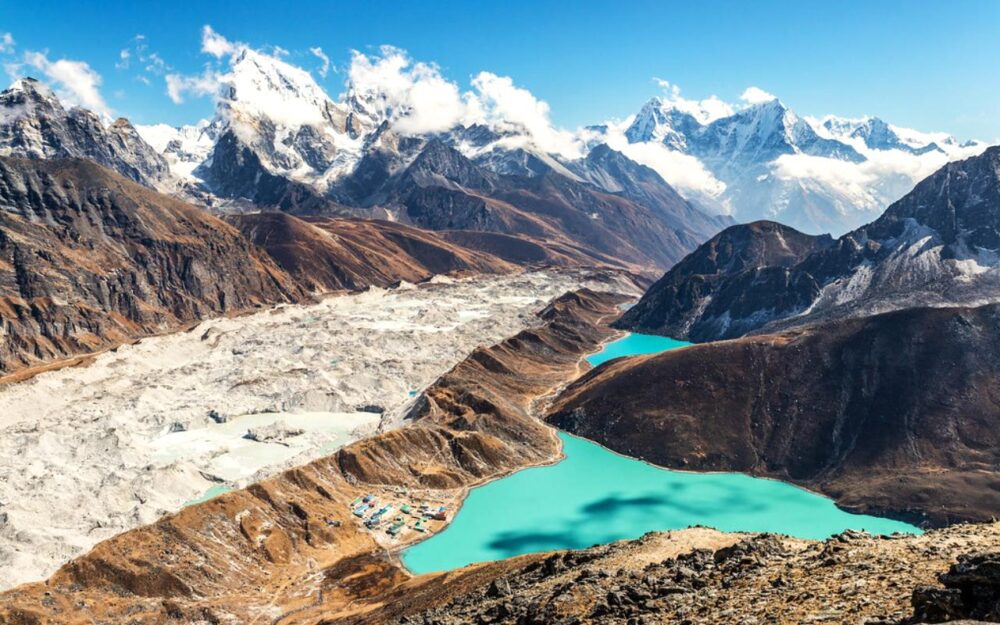
- Walk around the Third Lake’s 1.5-kilometer shore fed by Ngozumpa Glacier.
- Visit Monjo Sagarmatha National Park checkpoint, verifying permits since 1976.
- Sherpa farmers harvesting potatoes in Namche’s terraced fields.
- Visit Machhermo’s monasteries with active nunneries.
- Sherpa farmers using khurpas on barley fields near Machhermo.
Overview of Gokyo Lakes Trek – 14 days
The Gokyo Lakes Trek travels through Nepal’s Khumbu region within Sagarmatha National Park. You walk where Sherpa communities established villages in the 16th century. Gokyo village houses a few hundred residents, nearly all Sherpa. Their economy shifted after Tenzing Norgay’s 1953 Everest ascent.
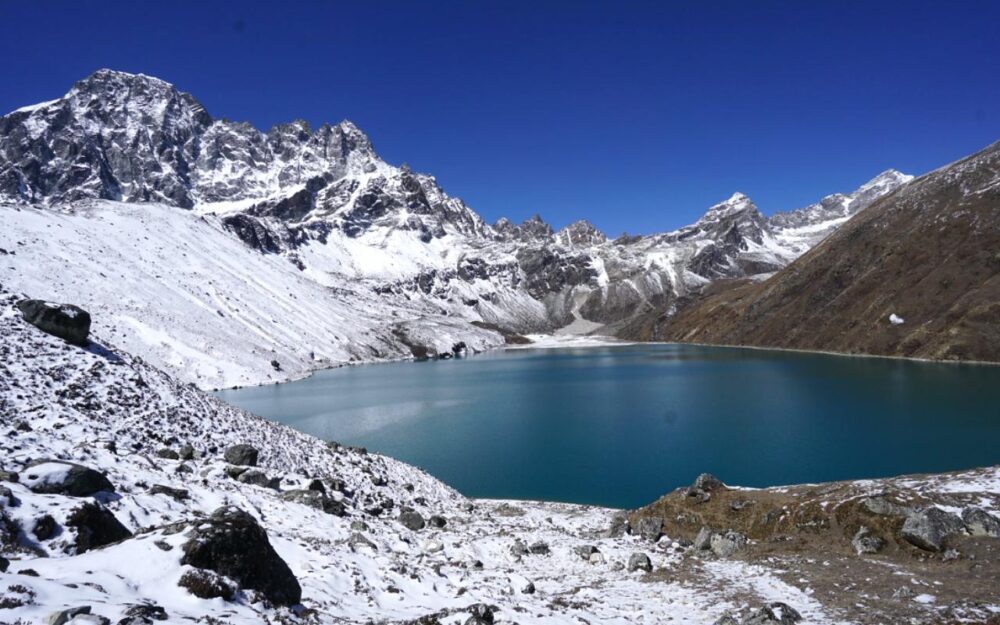
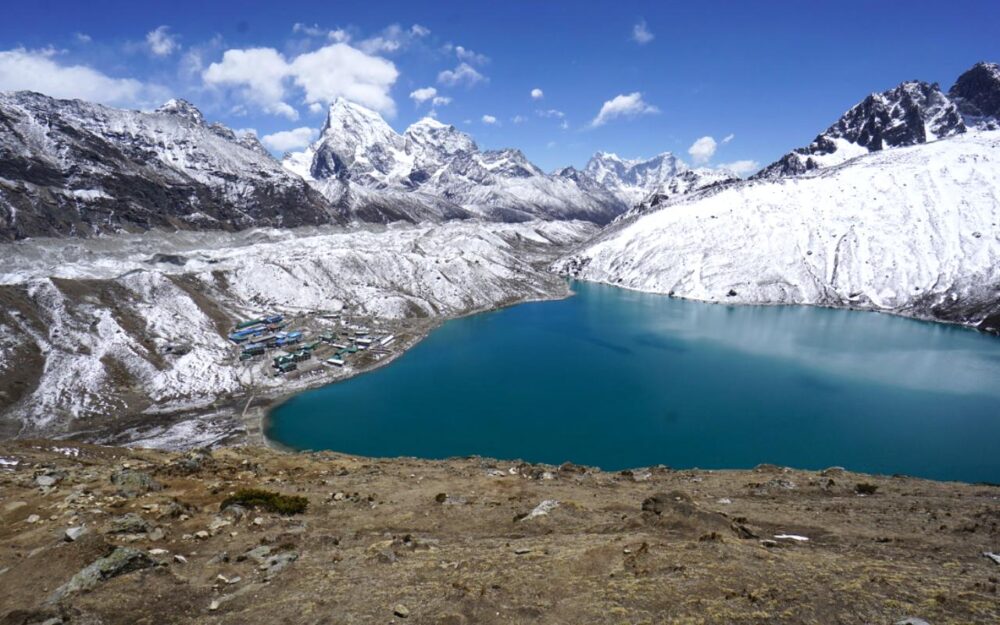
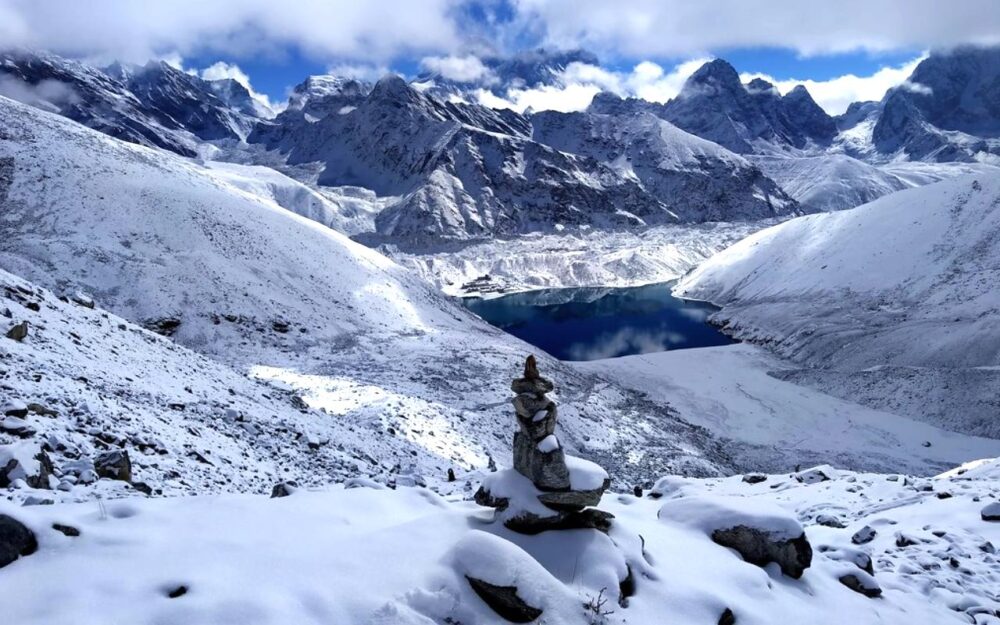
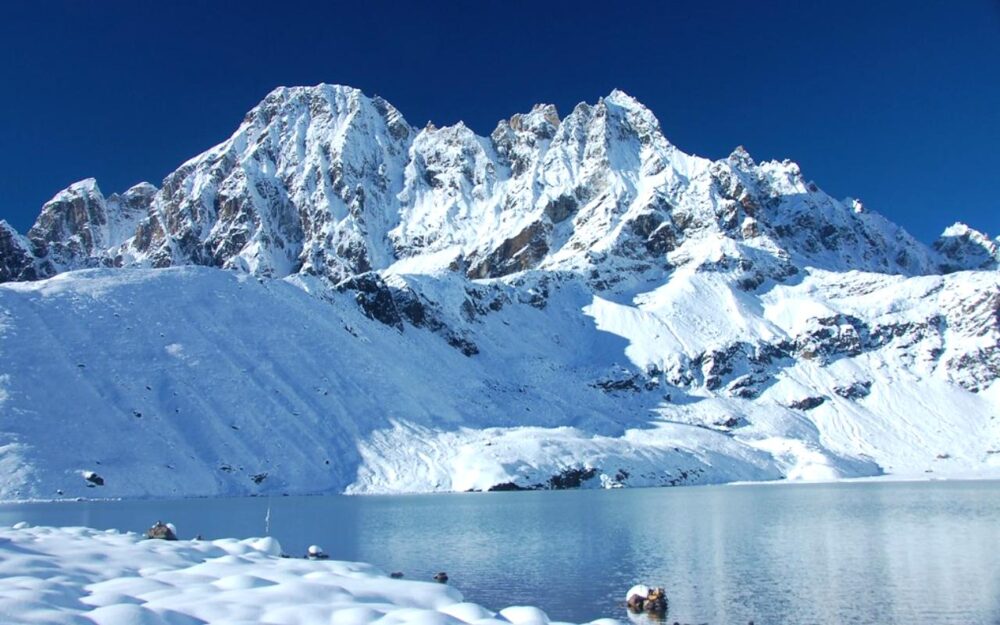
Six glacial lakes define this landscape. The third lake spans 1.5 kilometers at 4,700 meters. Its turquoise waters flow from the Ngozumpa Glacier. This 36-kilometer glacier is Nepal’s longest.
On this trek, you gain direct Everest views from Gokyo Ri’s 5,357-meter summit. This avoids Everest Base Camp’s crowds. En route, the Monjo checkpoint monitors 250 daily permits in peak season.
Teahouses serve dal bhat using potatoes from local terraced fields as much as possible. Farmers harvest hundreds of kilograms during October. Most of the produce ends up being consumed by the local communities, while the surplus amount is sold to higher region villages.
Lukla’s 527-meter runway operates daily flights with a limited transfer window. You witness ancient trade routes reshaped by modern climate shifts. Sherpa traditions persist through prayer wheels and butter tea stalls. Your journey connects you to communities adapting since the 1600s. Every step crosses terrain mapped by both yaks and satellites. This is where the Himalayas breathe today.
As your travel partner, Sonam Adventure will make sure that all the logistics are pre-arranged before you start your Gokyo Lakes Trek. This will ensure a seamless trekking experience through the remote mountains of the Himalayas. Our Gokyo Lakes Trek package is a flexible one, able to accommodate specific requests and preferences.
If you have any special modifications to the standard package, please contact one of our reps and work out the modified version so that we can arrange it all for you. This usually happens before booking the Gokyo Lakes Trek so that we can get back to you about the viability of the modifications.
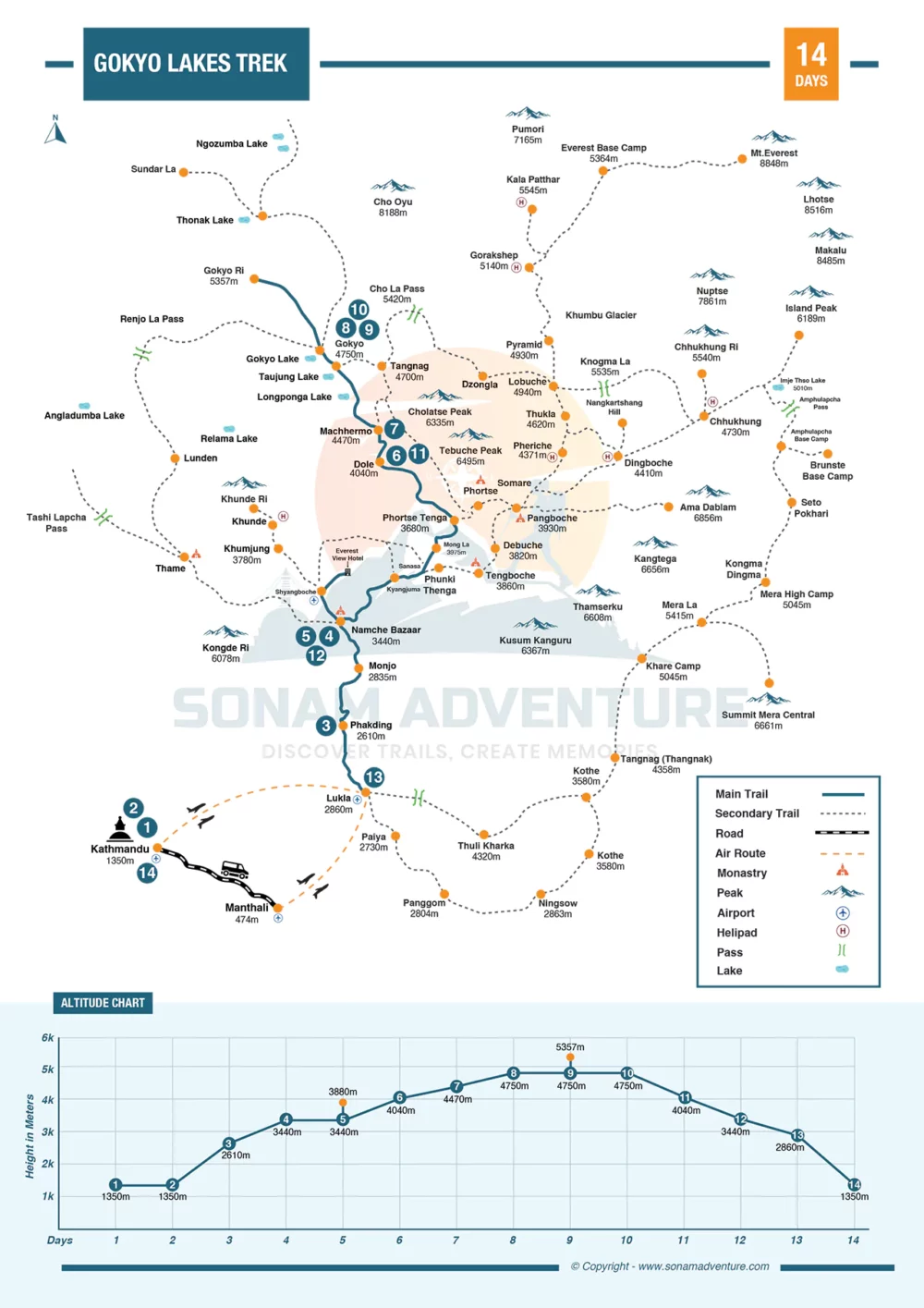
Itinerary of Gokyo Lakes Trek – 14 days
Day 01: Arrival in Kathmandu (1,400m)
Day 1 lands you at Tribhuvan International Airport in Kathmandu. You touch down at 1,400 meters, feeling the city’s pulse immediately. Airport chaos greets you with visa queues, customs stamps, and luggage claims.
Our Gokyo Lakes Trek team spots you fast. The drive to Thamel covers a couple of kilometers through Kathmandu’s living streets. Motorbikes swarm around your taxi. Ancient stupas peek between concrete buildings. Your elevation stays fixed at 1,400 meters. No climbing today.
This rest day serves one clear purpose: altitude adjustment. You skip hiking but stay active, walk Thamel’s narrow lanes and test your new trekking poles at local gear shops.
Evening brings cooler air within the valley. Sleep early in your quiet hotel room. Tomorrow’s Lukla flight demands sharp focus. Your body needs this calm before the mountains.

Accommodation
Hotel
Max Altitude
1400mDay 02: Rest day
Day 2 of the Gokyo Lakes Trek demands waking up at 1,400 meters, feeling Kathmandu’s altitude settle into your muscles. Today is for listening to your body, no mountains yet. Sleep feels essential after yesterday’s travel chaos.
You walk slowly through Thamel’s morning bustle. The guide points out hidden travel offices tucked between souvenir shops.
After a while, we will reach the Tourism Board office in Kathmandu. You hand over passports while the guide negotiates with officials in rapid Nepali. Processing takes around an hour or so. You use the wait to wander around at gear shops.
After we are done with that, lunch is simple: vegetable thukpa at a plastic-table stall. Carbs store energy for high passes, so our meals throughout the trek will be carb-rich.
Late afternoon, you walk to Boudhanath Stupa. The guide teaches you to spin prayer wheels clockwise. The scent of butter lamps fills the air.
Accommodation
HotelMeals
BreakfastDay 03: Fly to Lukla (2,840m), Trek to Phakding (2,610m)- 3hrs
Sunrise finds you at Kathmandu airport for the Lukla flight. Twin Otter planes wait on the tarmac. Boarding happens fast at 6:30 AM, starting the following day on the Gokyo Lakes Trek. The 35-minute flight follows river valleys north.
Lukla’s runway appears as a narrow strip on a mountainside. Pilots land on the 527-meter slope angled at 12 degrees. Touchdown happens at 2,840 meters of elevation.
You step into thin mountain air immediately. The trek begins with a descent alongside the Dudh Kosi River. Stone paths wind past Sherpa homes and prayer flags.
You cross three suspension bridges within the first hour. Steel cables vibrate and sway underfoot with each step. River water runs turquoise from glacial melt. Trail markers show constant elevation loss.
The full route covers 8 kilometers to Phakding. Net descent totals 230 meters to 2,610 meters. Temperature drops noticeably from Lukla’s morning chill. Rhododendron forests line higher slopes but stay bare now.
Porters pass carrying heavy loads balanced on head straps. Their steady pace eats up switchbacks efficiently. Phakding teahouses cluster near river confluences.
You arrive by noon after three hours of walking. This descent helps your body adjust after the flight. Sunset colors the valley walls gold. Sleep comes early to prepare for Namche’s climb tomorrow.

Duration
3 hrs trekAccommodation
TeahouseMeals
B L DMax Altitude
2839mDay 04: Trek to Namche (3,440m)- 6hrs
The next day of the Gokyo Lakes Trek starts early at Phakding’s river level. Your boots hit the trail by 7 AM. The path climbs steadily alongside the Dudh Kosi River.
You cross the iconic Hillary Suspension Bridge within 30 minutes. Its steel cables sway slightly under your weight. River depth reaches 4 meters here, fed by distant glaciers. The bridge marks the start of serious elevation gain.
The next 5 kilometers ascend 486 meters to Monjo village. Stone steps dominate a good portion of the trail. Pine and oak forests replace riverbank trails.
You pass through Sagarmatha National Park’s entrance checkpoint. Rangers verify your trekking permits quickly. Monjo sits at 2,805 meters, a crucial acclimatization checkpoint.
From Monjo, the trail steepens toward Namche Bazaar. You climb 635 meters over 7 kilometers. Switchbacks cut through terraced potato fields. Sherpa farmers work the slopes using traditional tools.
The temperature drops about 3°C compared to Phakding. You smell woodsmoke from stone houses as Namche appears. The final 500-meter climb tests your legs. You arrive by 1 PM after six hours of walking.
Duration
6hrs trekAccommodation
TeahouseMeals
B L DMax Altitude
3440mDay 05: Acclimatization in Namche, Hike to Everest View Hotel or Khumchung
The 5th day of the Gokyo Lakes Trek demands mandatory acclimatization. We stay in Namche Bazaar to let your body adapt. Oxygen levels here sit at about 65% of sea level.
Skipping this rest risks altitude sickness tomorrow or at some point later. You wake feeling stronger than yesterday morning. Our guides check your pulse oximeter readings before breakfast.
Two clear hike options open up. Choose the Everest View Hotel first. The 2.5-hour round trip gains 440 meters to 3,880 meters. Stone steps climb steadily through pine forests. The hotel terrace reveals Everest’s full profile at 8,849 meters above sea level.
The temperature drops 4°C compared to Namche’s main square. Some prefer Khumjung village instead. This 3-hour round trip gains 350 meters to 3,790 meters.
You walk past stone houses with flat roofs storing potatoes. The Hillary School stands as a landmark built by Sir Edmund Hillary. Both routes teach your blood to carry oxygen efficiently.
Duration
3hr hikeAccommodation
TeahouseMeals
B L DMax Altitude
3790mDay 06: Trek to Dole (4,200m)- 6hrs
We leave Namche Bazaar at 7 AM sharp. Oxygen levels sit at 59% of sea level on the 6th day of the Gokyo Lakes Trek. The trail climbs immediately through pine forests above the Dudh Kosi River. Stone steps dominate the first 3 kilometers.
Your lungs work harder with every switchback. You pass through Sanasa village at 3,600 meters by 9 AM. This checkpoint marks the valley exit. Trail conditions shift to open slopes with fewer trees. We stop for 10 minutes every hour. Short breaks prevent overexertion at this altitude.
The final 4 kilometers climb 625 meters to Dole. River crossings decrease as you gain height. You traverse rocky moraine terrain near Phortse Tenga’s outskirts. Dole appears at 12:30 PM after six hours of walking.
Teahouses cluster at 4,200 meters near glacial streams. Net elevation gain totals 760 meters from Namche. Eat warm dal bhat after about 30 minutes of stopping. Your body needs full recovery for tomorrow’s steeper climb to Machhermo.
Duration
6hrs trekAccommodation
TeahouseMeals
B L DMax Altitude
4200mDay 07: Trek to Machhermo (4,470m)- 4hrs
Day 7 of the Gokyo Lakes Trek starts at Dole’s 4,200 meters. We hit the trail by 7:15 AM after checking oxygen saturation levels. The 6-kilometer walk to Machhermo gains 270 meters of net elevation.
Initial switchbacks climb through rocky moraine left by retreating glaciers. Trail markers show consistent gradients for the first 2 hours. Mid-morning brings glacial stream crossings. We cross three narrow channels. Water runs ice-cold at 4°C from nearby glaciers.
The final 90 minutes traverse open valley floors. Trail conditions shift to packed gravel with minimal shade.
We enforce 10-minute breaks hourly to let your bodies regain stamina and catch breath. Drink 1 litre of water every 2 or 3 hours starting at 7 AM.
Dehydration risks rise significantly above 4,000 meters. Machhermo appears at 11:30 AM after 4 hours of walking. Teahouses group up at 4,470 meters near glacial streams.
Duration
4hrs trekAccommodation
TeahouseMeals
B L DMax Altitude
4470mDay 08: Trek to Gokyo (4,800m), visit first three lakes- 4-5hrs
Machhermo’s charming village serves as the starting point of the 8th day of the Gokyo Lakes Trek, at 4,470 meters of elevation. We depart by 7 AM after checking your water supply and a hearty morning meal.
The trail cuts across lateral moraines left by ancient glaciers. Rocky terrain demands steady footing for the first 90 minutes.
You climb 150 meters through boulder fields to Gokyo Valley’s entrance. The temperature sits 3°C cooler than the initial morning air as we are constantly gaining elevation.
Glacial streams cross the path repeatedly. We hop between stones set in fast-flowing meltwater. Water clarity stays high due to minimal sediment in the remote mountains.
Trail markers guide you past the first lake at 4,700 meters by 9:30 AM. Its turquoise color comes from fine rock flour suspended in meltwater. You circle the lake’s eastern shore on a flat 1-kilometer path.
The second lake appears at 4,750 meters above sea level. Steeper slopes rise here with visible glacial ridge lines. We take a 30-minute break near a stone shelter.
Drink water immediately to offset dry air. The third lake sits 200 meters higher, at 4,900 meters. Its outflow feeds the Dudh Kosi River system.
You descend slightly to reach Gokyo village at 4,800 meters by 11:30 AM. Net elevation gain totals 330 meters over 4-5 hours. Houses stay grouped near the third lake’s outlet.
Duration
4-5hrs trekAccommodation
TeahouseMeals
B L DMax Altitude
4800mDay 09: Hike to Gokyo Ri (5,357m) for sunrise view of Everest, Cho Oyu, and Makalu- 3-4hrs round trip
Day 9 begins in total darkness at 4 AM. Your headlamp beam cuts the dark path leading above Gokyo village. We start climbing immediately from 4,800 meters toward the Gokyo Ri summit. The first hour gains 250 meters on frozen scree slopes.
The temperature sits at -5°C, requiring gloves inside jacket sleeves. Switchbacks tighten as elevation increases. The trail follows a glacial moraine ridge with steep drops on both sides.
We enforce 30-second stops every 10 minutes to check breathing rhythm and regain a bit of stamina. Oxygen levels drop to around 50% of sea level at 5,000 meters. Avoid stopping longer than needed in the cold.
Sunrise hits the summit at around 6:15 AM. You reach 5,357 meters after 2 hours and 15 minutes of climbing. Everest’s summit pyramid appears 25 kilometers distant.
Cho Oyu dominates the western horizon at 8,188 meters. Makalu’s distinct pyramid rises 50 kilometers east. Wind chill measures -10°C, requiring immediate descent after photos.
The return trip takes 1 hour and 45 minutes. Net elevation gain totals 557 meters round-trip. Check your pulse oximeter within 5 minutes of returning to Gokyo.
Eat warm tsampa porridge immediately to restore core temperature. Your body proves its acclimatization progress today. This summit makes higher passes achievable.
Duration
3-4hrs hikeAccommodation
TeahouseMeals
B L DMax Altitude
5357mDay 10: Optional hike to 5th lake or rest day in Gokyo
The next day offers recovery at Gokyo’s 4,800 meters. We sleep until 8:30 AM, letting your body absorb yesterday’s summit effort.
This rest day prevents altitude sickness during tomorrow’s descent. Two clear choices open after breakfast, and the guide chooses to visit the fifth lake first. The 1.5-hour round trip gains 200 meters to 5,000 meters.
Trail markers follow glacial moraine ridges with minimal vegetation. Water temperature in the lake measures 2°C from direct glacier melt. Return before noon to avoid afternoon winds.
After that, you can enjoy village exploration as well. Walk Gokyo’s stone-paved lanes, checking prayer wheels and butter tea stalls. Visit the Gokyo Lakes Conservation Project office.
The temperature stays stable between 3-5°C all day. We enforce strict hydration targets: 4 liters minimum today.
Duration
1.5hr hike(optional)Accommodation
TeahouseMeals
B L DMax Altitude
5000mDay 11: Trek back to Dole- 6hrs
The 11th day of the Gokyo Lakes Trek drops you from Gokyo’s 4,800 meters toward Dole’s lower valley. Trail boots hit frozen ground at 7 AM sharp. We descend 600 meters over 6 hours through varied terrain.
Initial switchbacks cut across glacial moraine with loose scree underfoot. Your knees absorb each downward step to prevent strain. Since we are losing elevation, the temperature rises 5°C compared to Gokyo’s pre-dawn chill.
The trail transitions to packed gravel near the third lake. We cross three glacial streams using stable stone bridges. Water flows faster here with increased meltwater volume.
We enforce 10-minute breaks every 75 minutes to protect joints. Final descent follows the Dudh Kosi River valley.
Elevation loss accelerates through forested slopes near Machhermo. Dole appears at 1:30 PM after covering 12 kilometers. This drop prepares muscles for tomorrow’s Namche descent.
Duration
6hrs trekAccommodation
TeahouseMeals
B L DMax Altitude
4038mDay 12: Trek Namche- 5hrs
The following day of the Gokyo Lakes Trek moves you from Dole’s 4,200 meters toward Namche’s valley hub. We start walking at 7:30 AM after a filling breakfast and checking knee braces.
The 13-kilometer descent drops 760 meters over five hours. Initial trails follow glacial valleys with packed dirt paths. Your knees absorb each step’s impact. Temperature rises steadily as you lose elevation. Stone paths soften underfoot below 4,000 meters.
We cross over 10 different suspension bridges spanning the Dudh Kosi River. Steel cables vibrate with every step over milky river waters.
After a checkpoint, the trail cuts through potato fields. Sherpa farmers harvest using hand tools on terraced slopes. The temperature climbs significantly compared to Dole’s chilly morning air. Rhododendron forests thicken with visible green shoots.
Namche appears at 12:45 PM after five hours of walking. Your body adjusts faster, moving toward oxygen-rich air. Legs feel resilient after two high-altitude nights. Hydration remains non-negotiable during elevation loss.
Duration
5hrs trekAccommodation
TeahouseMeals
B L DMax Altitude
3440mDay 13: Trek to Lukla- 6hrs
The 13th day of the Gokyo Lakes Trek moves you from Namche’s 3,440 meters toward Lukla’s airstrip. Trail boots hit packed dirt paths at 7:45 AM.
We descend 600 meters over 18 kilometers in six hours. Stone steps dominate the first 1.5 hours of the trail through pine forests. Your knees absorb each downward step using a slight bend as trekking poles plant firmly before every footfall.
Temperature rises steadily as oxygen levels increase. The trail shifts to river valley paths below 3,000 meters. We cross around eight suspension bridges spanning the Dudh Kosi.
The final part of today’s trek cuts through plantations and farms near Phakding. Air thickens noticeably with humidity at 2,840 meters. Rhododendron blooms appear in shaded clearings.
Lukla’s airstrip comes into view at 1:30 PM after six hours of walking. The guide checks flight status immediately upon arrival.
Duration
6hrs trekAccommodation
TeahouseMeals
B L DMax Altitude
2840mDay 14: Fly to Kathmandu
The last day of the Gokyo Lakes Trek starts with an early Lukla airstrip call. We meet at 6 AM for the 7:15 AM flight window.
Twin Otter planes line the sloped runway at 2,840 meters above sea level. The 527-meter runway slopes downward, an exciting feature that most runways don’t have. Takeoff happens within 20 minutes of boarding.
The 35-minute flight descends 1,440 meters to Kathmandu’s 1,400 meters. Oxygen levels rise to 86% of sea level during the flight.
You notice thicker air filling your lungs immediately after landing. Tribhuvan Airport’s domestic terminal greets you with humid warmth.
Our team meets you outside arrivals with bottled water and transport. The 5-kilometer taxi ride to Thamel takes 20 minutes through morning traffic.
Check into your hotel by 9:30 AM. Drink electrolyte water immediately to counter dehydration. We provide a detailed trek completion report with elevation logs. Take a short walk to test Kathmandu’s sea-level air.
Eat a light lunch of dal bhat to reset digestion. Sleep feels deeper without mountain thinness. This transition completes your Himalayan journey safely.
Accommodation
HotelMeals
BreakfastMax Altitude
1400mTrip Information - Good to Know
How does the trip start?
Your trip starts at Kathmandu airport after clearing customs. We will meet you within 15 minutes, holding a name sign. You board our vehicle for the drive to Thamel. Check into your hotel after a 30-minute ride.
Our guide confirms permits from the Nepal Tourism Board the next day. Gear shops stay open till late at night to accommodate the late arrivals. No hiking occurs today. This physiological pause helps in preventing altitude sickness later.
Difficulty
Difficulty centers on sustained high elevation exposure. You sleep six nights above 4,000 meters. Day 6 demands 760 meters of climbing over 6 hours at 12% average grade. Gokyo Ri requires a 557-meter pre-dawn climb in -5°C conditions.
Trail surfaces test stability: loose scree on moraines, icy switchbacks, vibrating suspension bridges over 4-meter deep glacial streams. There are many difficulties on Gokyo Lakes Trek, mostly physical and some physiological, giving it an 8 out of 10 on the difficulty scale.
Best seasons
The best seasons are October to November and March to May. October offers 80% clear skies with 10°C daytime temperatures at Namche. Pre monsoon April provides rhododendron blooms between 2,500 and 3,500 meters.
Avoid monsoon June September when the Dudh Kosi River depth triples to 6 meters, washing out trails. Winter December February brings -15°C summit temperatures with flight cancellation risk from Lukla.
Altitude Sickness
Altitude sickness prevention drives our schedule. We enforce two acclimatization days at Namche and Gokyo. Drink 3 liters of water daily, minimum, starting Day 1. Our guides check pulse oximeter readings twice daily. We halt climbs if saturation falls below 85%.
Severe and prolonged headaches require immediate descent of 300 meters. Acclimatization days prevent 70% of altitude sickness cases.
Accommodation, Food and Drink
Accommodation uses basic teahouses with shared bathrooms. Mattresses measure 5 centimeters thick on wooden frames. Solar panels provide 2 hours of electricity daily for phone charging. Meals follow Nepali mountain traditions. Dal bhat (lentil soup with rice) arrives within 30 minutes of ordering.
We recommend warm soup consumption within 10 minutes of arrival. Water boils for 5 minutes minimum before drinking. Teahouses sell bottled water at $2 to $4 per liter, depending on the elevation. 3 meals a day and accommodation throughout the trek are included in the Gokyo Lakes Trek package.
Transportation and Permit
Transportation relies on Twin Otter flights and simple cars or jeeps. The 35-minute Kathmandu to Lukla flight rises 1,440 meters in elevation. Permits cost $30 through the Nepal Tourism Board.
You need two documents: a TIMS card and a Sagarmatha National Park entry. The guide permits in Thamel within 2 hours of arrival. We confirm flight status daily by 5 AM. Ground transport uses basic cars for Kathmandu transfers. All transportation required by the itinerary, along with permits, is a part of the Gokyo Lakes Trek package.
Trip preparation and fitness
Start training 8 weeks before departure. Walk 15 kilometers weekly carrying 5 kg packs. Incorporate stair climbing 4 times weekly. Test your new boots on 20km walks to break them in. Pack trekking poles for 70% of the trail sections. Make sure that you have packed all your essentials, for some this can be meds, while others might need heavy sunscreen protection.
Cost & Budget
The base price of the Gokyo Lakes Trek package is USD ______ per person. This includes Lukla flights, permits, 13 nights teahouse stays, daily food costs for three meals, etc. Budget for extras: bottled water ($2-4/liter above 4,000m), phone charging ($1/hour), and tips. We provide detailed receipts and a rough estimate of your expenses before we join the Gokyo Lakes Trek.
Your Extra expenses
You have to pay separately per liter for bottled or boiled water throughout the Gokyo Lakes Trek. Phone charging costs around a dollar per hour at teahouses. Buy local SIM cards for $1 at Kathmandu airport. Budget $15 daily for snacks like roasted corn or chocolate bars. Tip guides $10 daily and porters $5 daily. Flight delays add $30 per night for Lukla hotel stays.
Purchase iodine drops for $3 at Thamel gear shops. Budget $20 for emergency oxygen above 5,000 meters. Carry $50 for unplanned taxi rides in Kathmandu. We provide exact expense breakdowns before departure. Avoid street money changers if you want the best exchange rate.
Frequently Asked Questions
How many porters will be there in the group?
The total number of porters depends on the size of the group. Normally, we provide one strong porter for every two trekkers.
What is the procedure for severe altitude sickness?
In severe cases, the guide will contact emergency evacuation services to get you to the nearest hospital.
How many people are in a group?
Excluding the porters and guides, there are a maximum of 8 to 10 people in a group.
What gear should I pack before flying to Kathmandu?
You do not have to pack trekking gear before coming to Nepal. Renting gear is the best option since trekking equipment is heavy and not easy to transport over a long distance.
Trip Reviews
 Write a Review

How to book a trip?

make free inquiry

